
Human Flourishing in the Age of AI
This essay is a follow-on to The Displacement of Cognitive Labor and What Comes After, which lays out the trajectory: AI automating all categories of human labor, the shift toward radical abundance in produced goods, and the challenges of both the transition period and the world that follows. This essay takes up what I believe is the most important of those challenges: how to promote genuine human flourishing in a world where material needs are met and productive labor is optional.
I. The Central Question
This is personal for me. We may be the last generation that has to work for a living. Our children will likely grow up in a world where having a career is a choice, not a necessity. That’s an extraordinary thing to say, and it changes what it means to be a parent right now. The world I’m preparing my kids for is so radically different from any world that has previously existed that most of the inherited wisdom about how to raise children (study hard, get good grades, build a career) will be irrelevant. This essay is an attempt to think clearly about the world I want to raise my kids in, and what that world needs to look like for them to grow into full, developed human beings rather than comfortable, stagnant ones.
Everything in the previous essay converges on a single question: will abundance produce human flourishing, or will it produce comfortable stagnation?
This is not a question that markets solve. Markets are optimized for preference satisfaction, and preference satisfaction in a world of limitless supply converges on hedonic optimization: maximum comfort, maximum stimulation, minimum friction. That’s not flourishing. That’s an experience machine.
It’s also not a question that technology solves by default. AI that’s optimized for engagement, satisfaction, or even “helpfulness” in the conventional sense will tend to give people what they want in the moment rather than what they need for growth. A system that genuinely supports development would sometimes need to challenge, frustrate, and withhold: the opposite of what makes products engaging.
Flourishing in a post-economic world requires something we don’t yet have: cultural infrastructure for meaning-making beyond material contribution. New frameworks for what a valuable life looks like when productive labor is no longer the organizing principle. Building this infrastructure is, in my view, the most important work of the next decade. The default path leads to comfort without growth. Changing the default requires designing for human development with the same rigor and ambition that we’re applying to artificial intelligence.
II. A Framework for Development
Developmental psychology offers the most useful lens I’ve found for thinking about what flourishing actually means. Robert Kegan’s framework describes stages of adult psychological development that determine not just what people want but how they relate to their own wanting.
Stage 3 is the socialized mind. This is the person who wants to be a lawyer because their parents and peer group value that path, and they’ve never really examined whether it’s what they independently want. Their desires and values are inherited from their social environment. Most adults operate here.
Stage 4 is the self-authoring mind. This is the person who examined the expectation to become a lawyer, weighed it against their own values, and either chose law for their own reasons or chose something else entirely. The point isn’t what they decided but that the decision was genuinely theirs, generated from an internal value system rather than absorbed from the outside.
Stage 5 is the self-transforming mind. This is the person who built that internal value system, lives by it, and can simultaneously see its limitations. They might be a deeply committed lawyer who also recognizes that their commitment to justice is one framework among many, that it has blind spots, and that other people’s fundamentally different frameworks have their own validity. They hold their identity without being held captive by it.
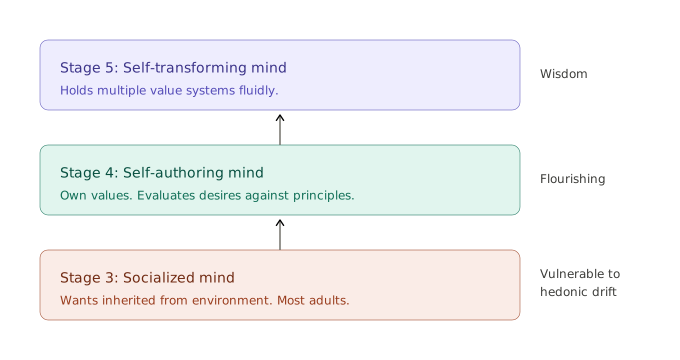
This matters because abundance without developmental growth is a trap. A stage 3 person in a world of infinite choice and no material constraint is profoundly vulnerable. Their wants are shaped by whatever signals are loudest in their environment, which in practice means algorithmically optimized content, social comparison, and the path of least resistance toward comfort and stimulation. Abundance doesn’t help them develop. It can actively prevent development, because material struggle is one of the forces that historically pushes people toward greater psychological complexity.
The optimistic path, where abundance leads to genuine flourishing, requires that people grow through these stages: from having their identity defined by external forces, to authoring their own meaning, to holding meaning itself with openness and flexibility. But every developmental framework we have was built in a context of scarcity. Maslow’s hierarchy assumes you ascend through meeting lower needs. What if all the lower needs are met from birth? Do people naturally reach for self-actualization, or do they settle into comfortable stasis?
The evidence from affluent populations isn’t encouraging. The wealthiest societies on earth have rising rates of depression, anxiety, and reported meaninglessness. Removing constraint seems to remove a developmental engine without automatically replacing it with anything.
This is not a minor footnote to the post-economic transition; it is arguably the central problem. A civilization that achieves material abundance but fails to support human development hasn’t reached utopia. It’s built a very comfortable cage.
III. Two Dimensions of Flourishing
Human flourishing is really two intertwined challenges, and conflating them leads to confusion about what needs to be done and by whom.
The first is individual development: helping specific people grow from one developmental stage to the next. This is the Upper Left quadrant in Ken Wilber’s integral framework, the interior life of the individual. How does a particular person move from having their values inherited from their environment to authoring their own? From authoring their own to holding them with flexibility? This is the domain of coaching, therapy, reflective practice, and (I’ll argue) well-designed AI tools. The interventions are personal and happen one person at a time.
The second is cultural evolution: shifting what a society collectively believes a good life looks like. This is Wilber’s Lower Left quadrant, the shared interior of a group. Right now, the dominant culture celebrates professional achievement, wealth accumulation, productivity. That entire value system is about to become obsolete. You can have a thousand individually developed stage 4 people, but if the culture around them still celebrates consumption and status competition, the gravitational pull back toward stage 3 behavior is enormous. Cultural evolution requires different interventions: artists, philosophers, spiritual traditions, media, education systems, community design.
The interdependence between these two dimensions is the key insight. Individual growth without cultural support is fragile (the developed person swimming against a culture that doesn’t value development). Cultural narratives without individual development are hollow (a society that says it values wisdom but whose members can’t actually practice it). They have to co-evolve.
IV. Designing for Individual Development
AI as Developmental Partner
The dominant AI design paradigm today is concierge logic: give the user what they want, faster and more conveniently. Flourishing requires a fundamentally different orientation. In key moments, the most valuable thing an AI can do is not satisfy a request but introduce productive friction, reframing, or challenge.
Consider what a good developmental interaction looks like. You come in with a set of observations or beliefs. A thoughtful partner pushes back on the weak points, surfaces assumptions you didn’t know you were making, and helps you arrive at a tighter, more rigorous version of your own thinking. You leave the interaction not with answers handed to you but with a framework you built yourself, stress-tested against genuine resistance. That’s not a service interaction. It’s a growth interaction. And it’s precisely what most AI products are not designed to do, because challenge and friction reduce short-term satisfaction metrics even as they increase long-term development.
Building this requires a design orientation that optimizes for the user’s growth over time rather than their satisfaction in the moment. An AI developmental partner would need to understand where a person is in their psychological development, what kinds of challenges would be productive for them right now, and how to introduce those challenges in a way that’s supportive enough to be tolerable but demanding enough to force genuine growth. For someone at Kegan’s stage 3, this might mean helping them notice when their desires are inherited from their social environment rather than self-generated. For someone at stage 4, it might mean helping them see the limitations of their own self-authored system. The interaction model is closer to a great coach or therapist than to a search engine or assistant.
Helping People Discover What They Want
There is a version of AI personalization that predicts your preferences and serves them back to you: you usually order Thai food on Thursdays, so here’s a Thai restaurant recommendation. That’s useful but developmentally inert. The more valuable capability, and the harder one to build, is helping people discover what they want at a deeper level than surface preferences.
This means pattern recognition applied not to consumption habits but to life trajectories. “You keep starting creative projects and abandoning them, and here’s what I think that pattern means.” “You say you value independence but every major decision you’ve made in the last two years has prioritized security. Here’s what that tension might be about.” “You’re spending most of your time on things you’re good at but don’t seem to care about. What would it look like to take the thing you actually care about seriously?”
This is what the best human coaches and mentors do: they accumulate context over time and use it not to serve you more efficiently but to reflect you back to yourself in ways you can’t achieve alone. They surface things you can’t see from inside your own frame. An AI system designed for this would need a long-term developmental relationship with the user, building context over months and years, and it would need the design courage to say things the user didn’t ask to hear.
This is buildable. The underlying capabilities exist: long-context memory, pattern recognition across behavioral data, the ability to hold multiple interpretive frames simultaneously. What’s missing is the product design and the willingness to optimize for something other than engagement and satisfaction.
V. Designing for Cultural Evolution
Technology can build the tools for individual developmental partnership, but the cultural dimension of flourishing requires something broader.
Community and relational infrastructure is one piece. Flourishing probably can’t happen in isolation, even with a perfect AI developmental partner. Kegan’s research shows that growth happens in “holding environments,” communities that simultaneously support and challenge their members. The post-economic world needs new forms of community that aren’t organized around work (since work is gone) or consumption (since everything is free). These might be organized around shared developmental practice, creative collaboration, or stewardship of place and land. Building these communities is a cultural and political project, not a product.
The narrative problem is another. People need a story about what a good life looks like, and the current story (work hard, build skills, achieve professional success, provide for your family) is about to break. What replaces it needs to come from artists, philosophers, spiritual teachers, and storytellers, potentially amplified by AI but not generated by it. A narrative that values developmental growth, relational depth, creative expression, and spiritual maturity as the point of being alive, not as hobbies you pursue after work. That’s a cultural shift that requires human leadership.
And the design of productive struggle is a third piece. If struggle drives growth and material struggle is disappearing, new forms of challenge need to exist: genuine difficulties that people opt into because the challenge itself is meaningful. Games, athletic pursuits, contemplative practices, creative endeavors with real standards, intellectual expeditions where failure is possible. Creating the conditions and cultural permission for this kind of voluntary difficulty is not something a technology company can do alone. It requires a society that values growth over comfort, which is ultimately a philosophical commitment.
Individual development and cultural evolution need to advance together. AI developmental tools without cultural infrastructure for meaning-making will reach only the people who are already inclined toward growth. Cultural narratives about flourishing without technological tools to support the hard daily work of development will remain aspirational. The full picture requires both, and the work on both fronts needs to start now.
VI. Building the Interface for Human Development
If the AI-human interface is where developmental interactions happen, then the design of that interface matters as much as the capabilities of the underlying AI. This is where voice becomes critical. Text-based AI interactions tend to be transactional: ask a question, get an answer, move on. Voice conversations naturally drift into thinking-out-loud territory, the kind of unstructured reflection where people process what they actually think and feel rather than performing a polished version of it. That reflective mode is where developmental value lives.
At Wispr, we’re building a voice-native interface to AI. That positions us not just as an input method but as the layer that shapes how people relate to AI over time. The design choices we make in that layer determine whether AI interactions are purely transactional or whether they have the potential to support genuine growth. A few concrete directions illustrate what this looks like in practice.
The first is reflective prompting built into the interaction model. When someone voices a decision or intention, the system doesn’t just execute. It occasionally asks: why does that matter to you? Or: you said something similar last week and then changed your mind, what’s different now? Not every time, because that would be intrusive, but often enough that the user starts to develop a reflective relationship with their own stated intentions. This is lightweight, doesn’t require the user to opt into a growth program, and it’s the kind of thing a voice interface can do much more naturally than a text interface because it mirrors how good conversations actually work. Nobody finds it strange when a person they’re talking to asks a follow-up question. They do find it strange when a text box challenges them.
The second is long-term pattern surfacing. The system accumulates context across weeks and months of voice interactions and periodically reflects patterns back to the user. Not consumption patterns but behavioral and intentional patterns. You’ve mentioned wanting to write more three times this month but haven’t started. What’s in the way? This is the “discover what you want” capability in practice, and it requires persistent memory plus the design willingness to surface uncomfortable observations. Voice is the right modality because this kind of observation lands very differently spoken than written. Written, it reads like a notification or a judgment. Spoken, it feels like a friend noticing something.
The third is reframing before execution. When someone asks for help with a task, the system has a layer that considers whether the task as framed is actually what the person needs. Not blocking execution, but occasionally offering an alternative frame. You asked me to draft an angry email to your colleague. Before I do that, it sounds like the real issue is that you feel unheard in meetings. Do you want to talk about that instead? This is developmental in a subtle way: it trains the user over time to notice the gap between their surface request and their underlying need.
The fourth is the voice-native second brain. Wispr’s quick-capture capability, the ability to speak a thought and have it captured, organized, and stored, can be designed not just as a place to dump fragments but as a system that reflects those fragments back over time. Voice-captured thoughts accumulate into something the AI can synthesize: here are the themes you’ve been circling for the last month. Here’s what seems unresolved. Here’s a contradiction between something you said Tuesday and something you said today. This turns thought capture from a storage tool into a developmental mirror, a system that helps you see your own thinking from the outside, which is one of the hardest and most valuable things a person can learn to do.
None of these features require the user to understand developmental psychology, to consciously pursue growth, or to be at any particular stage of psychological development. They meet people where they are, in the natural flow of talking to an AI about their work and their lives, and they create the conditions for growth to happen incrementally, almost invisibly. A stage 3 person who uses a voice AI that occasionally reflects their patterns back to them will, over months and years, start to notice things about themselves that they couldn’t see before. That noticing is the beginning of the transition to stage 4. It doesn’t require a curriculum or a program. It requires an interface designed with development in mind.
This is what it means to build for flourishing at the interface layer. Not a separate product for personal growth, but a design philosophy embedded in the primary way people interact with AI. The voice interface isn’t just an input method. It’s the relationship through which AI can support human development at scale, one conversation at a time.
We are building the most powerful technology in human history. The question of what it’s for, beyond production, beyond efficiency, beyond convenience, will define whether the next century is humanity’s finest or its most tragically wasted. The transition to a post-economic society is coming whether we prepare for it or not. But whether we arrive as a flourishing civilization or a comfortable but diminished one is not yet determined. That outcome depends on the choices we make now: what we build, what we optimize for, and whether we have the courage to design for human growth rather than human comfort. The window to shape that outcome is open, and it won’t stay open forever.
Comments